How Schools Can Connect Kids to Benefits
Schools and Summer EBT
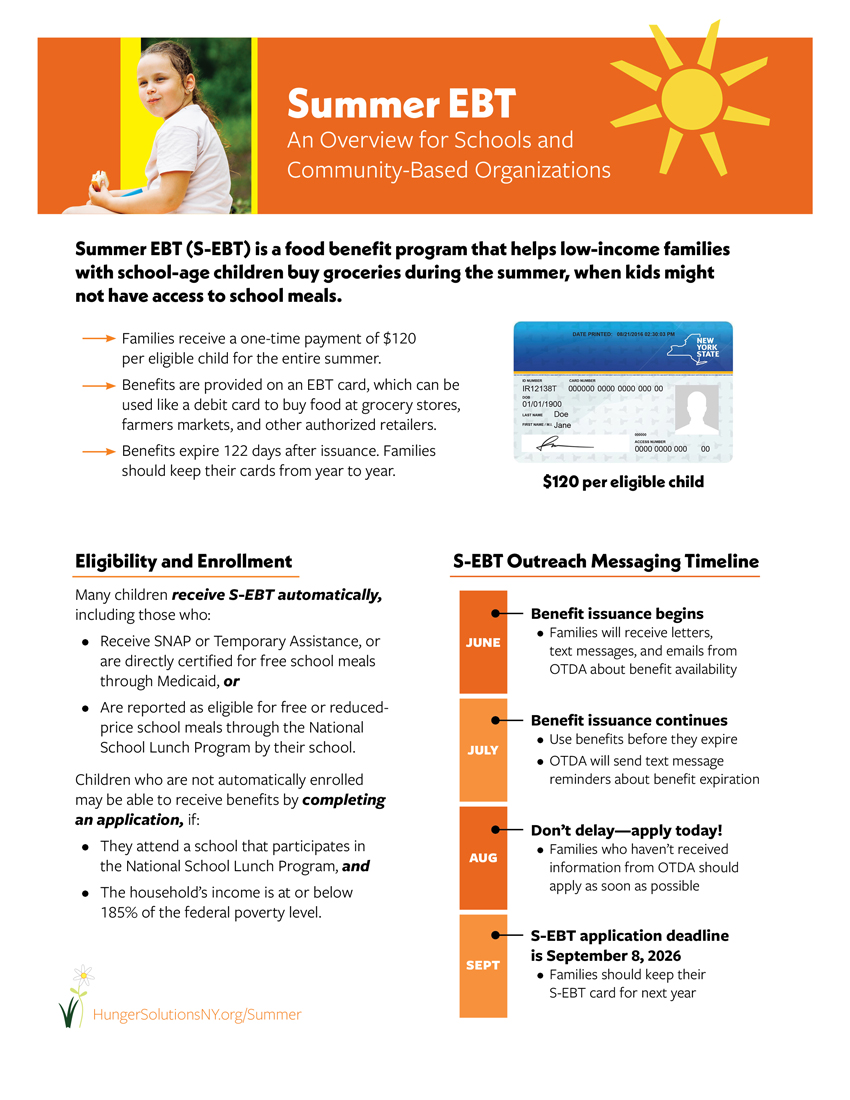
Summer break can increase hunger for kids and teens. Summer EBT (S-EBT) is an annual food benefit program that helps low-income families with school-age kids buy food during the summer when school meals are no longer available.
Most Eligible Students are Automatically Enrolled in S-EBT
Schools play a crucial role in this process by providing student-level enrollment and demographic data to the New York State Education Department (NYSED). The New York State Office of Temporary and Disability Assistance (NYSOTDA) accesses this data to issue benefits to families.
Schools Help Facilitate Automatic S-EBT Enrollment
Students who are automatically enrolled in Summer EBT fall into two categories:
- Students ages 6 to 16 who receive SNAP or are directly certified for free school meals through Medicaid. Benefits are issued to these students without requiring the use of school-level data.
- Students of any age who have been reported as eligible for free or reduced-price school meals by their school district. Benefits are automatically issued using student-level data submitted to NYSED through the Student Information Repository System (SIRS) or, for private, non-public schools, through NYSED’s Information and Reporting Services (IRS). This data is used to determine eligibility, issue benefits, communicate directly with families, and mail S-EBT benefit cards.
Summer EBT Eligibility and Universal School Meals:
- Providing free meals to all students does not establish S-EBT eligibility for all enrolled students.
- Schools that collect alternative household or family income forms instead of FRPL applications must collect all of the information included on NYSED’s alternate eligibility form to meet the requirements to determine Summer EBT eligibility.
- Students who are FRPL-eligible through an alternate eligibility form are subject to a state-level verification process. Schools do not need to take any action, but could potentially receive questions from families whom NYSOTDA has contacted for verification.
- Families with eligible students who do not complete an alternative eligibility form need to complete a Summer EBT application to receive benefits.
Best Practices for Schools to Connect Eligible Families to S-EBT
Submitting accurate, up-to-date student-level data and communicating with families are key:
Ensure students’ free/reduced-price lunch (FRPL) status is accurate.
Each student must be individually determined eligible for FRPL to receive S-EBT benefits. This includes children approved for free meals through a FRPL application and those who are directly certified for free school meals without an application—such as students certified as homeless/runaway, migrant, or in foster care, and those enrolled in Head Start. It is very important to include the method used to certify each child as FRPL eligible.
Ensure student enrollment and demographic data is up-to-date.
This information is used to mail S-EBT benefit cards and send notifications directly to families. Inaccuracies lead to delayed or missed benefits for families. The most critical data points to maintain for Summer EBT are mailing addresses, date of birth, and the child’s legal guardian.
Have student-level data ready before the end of February.
NYSED pulls data for S-EBT from SIRS/IRS at the end of February to submit to NYSOTDA. Schools should update student data with this timeline in mind, as the bulk of S-EBT benefits are issued using this data set. An additional data exchange between NYSED and NYSOTDA occurs during the summer to capture updated end-of-school-year enrollment information.
Share information about Summer EBT with parents and caregivers.
As trusted messengers, schools can help families learn about the S-EBT program. Before the school year ends, tell families about S-EBT and the availability of summer meals. At the start of each school year, remind families to use their benefits before they expire, which happens 122 days after the benefits have been issued. Hunger Solutions New York and NYSOTDA have ready-made communications resources to help.
Tips for Success and Resources
- Collaborate within your school district. The student data required for S-EBT involves multiple stakeholders within your school who work with data (i.e., administrators, business officials, school nutrition, and IT).
- Use direct certification best practices to maximize the number of students automatically certified for free school meals without an application. Our tipsheet provides key strategies for schools.
- Leverage ready-to-use Summer EBT outreach resources—including flyers, sample text, and graphics—available from both the NYSOTDA and Hunger Solutions New York.
Additional Summer EBT Resources for Schools
NYSED P20 Weekly S-EBT Information for Schools
NYSED Office of Information and Reporting Services’ FAQ for S-EBT
NYSOTDA S-EBT Information for Schools
Stay up to date
Get the latest news, action alerts, press releases, and hunger research delivered to your inbox.