The National School Lunch Program makes it possible for millions of children to receive a nutritious lunch every school day, in an affordable, convenient way.
National School Lunch Program
The National School Lunch Program provides an essential meal every school day to support children’s growth, learning and long-term well-being.
Research shows that school meals are the most nutritious food source for children—regardless of income level—and that health, behavior, and academics improve when children participate. This vital program is among our nation’s most powerful, reliable tools to safeguard food security and affordability for families with children.
School Lunch in New York
- All public schools, nonprofit private schools, and residential child-care institutions are eligible to participate.
- Under NY’s statewide universal free school meals legislation, all schools participating in the federal school lunch or breakfast programs are required to provide reimbursable school meals at no cost to all students.
- All meals must meet federal nutrition standards, which require a balance of whole grains, fruits, vegetables, low-fat or fat-free milk, and lean protein, and limit added sugar, calories, and sodium.
- Schools receive state and federal reimbursement for each lunch served. Under universal free school meals, all meals served are reimbursed at the federal free rate for the current year.
- Administered at the federal level by the U.S. Department of Agriculture’s Food and Nutrition Administration (USDA-FNA), and at the state level by the New York State Education Department’s (NYSED) Child Nutrition Program Administration.
Requirements for Schools to Maximize Federal Reimbursements
Per NYS Universal Free School Meals legislation, all school districts, charter schools and non-public schools that participate in the National School Lunch and Breakfast Program (also referred to as School Food Authorities—SFAs) are required to:
- Operate either the Community Eligibility Provision (CEP), if eligible, or Provision 2
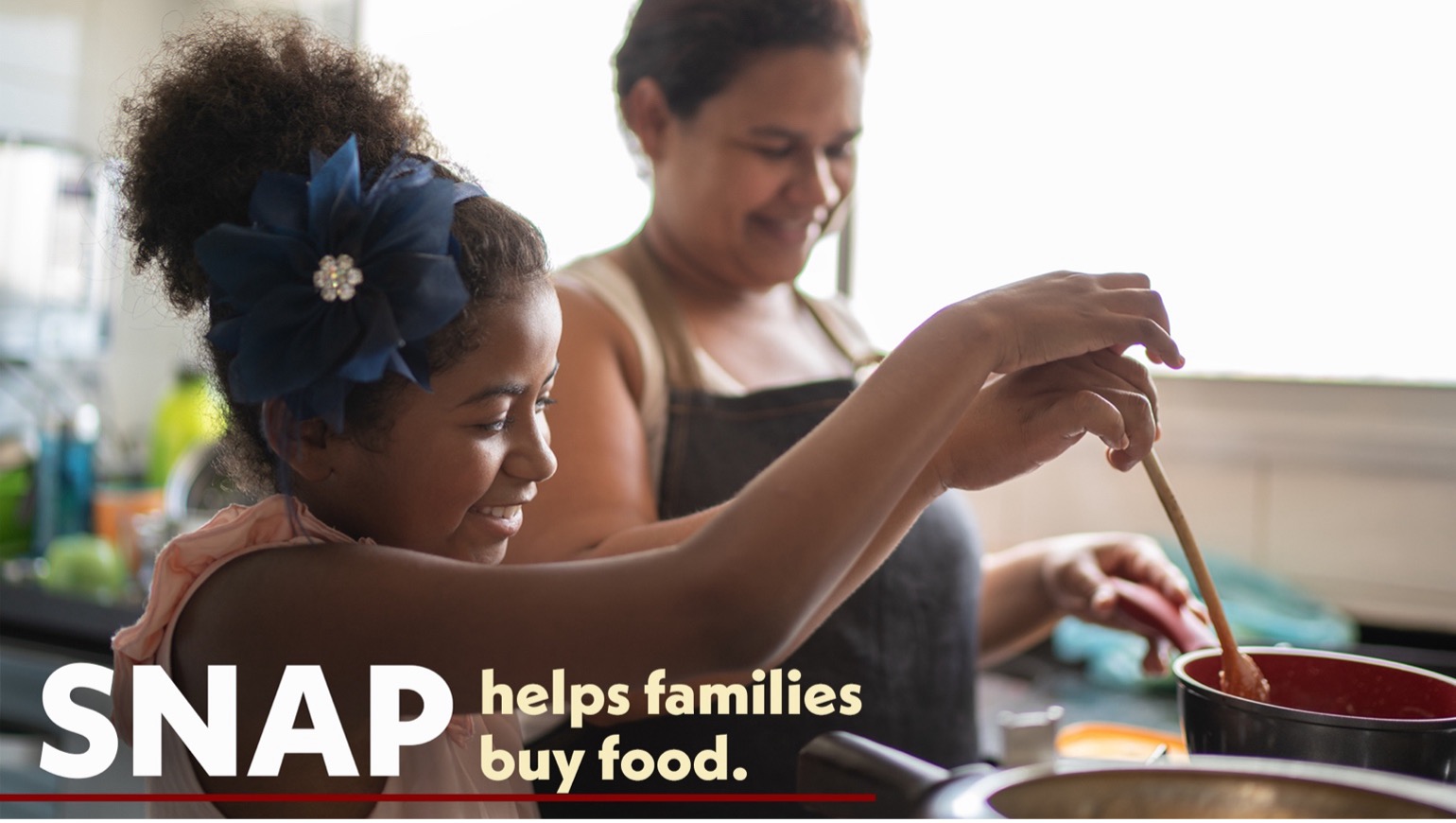
- Actively promote SNAP to students and their parents
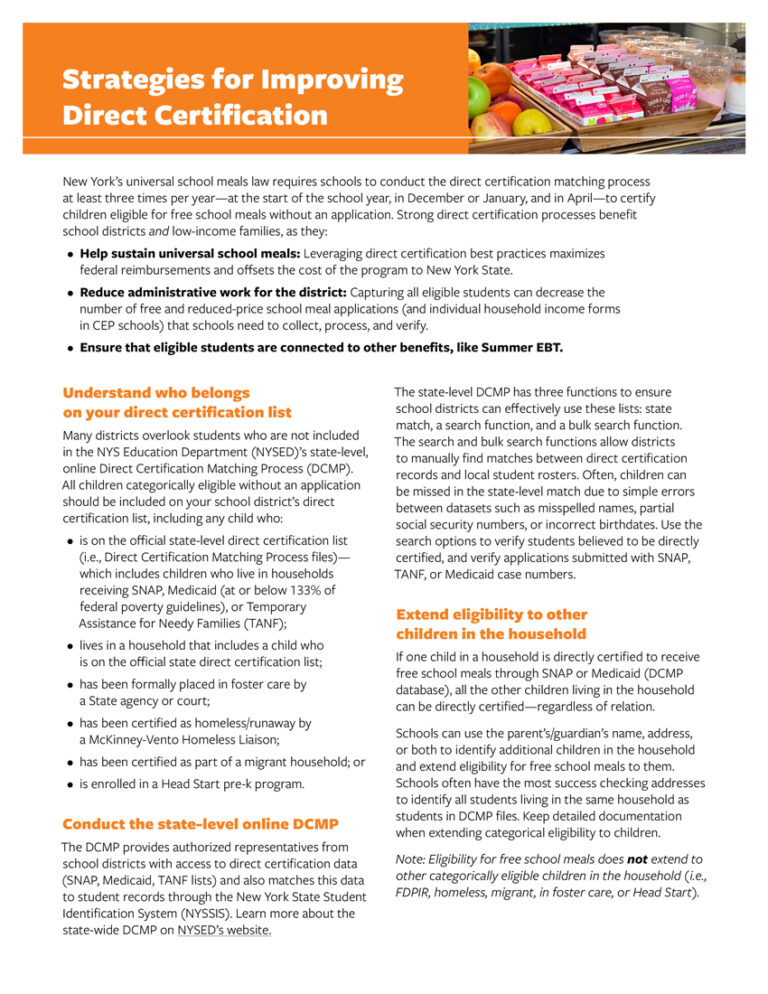
- Conduct direct certification matching at least three times per year to maximize the number of students automatically eligible for federal free meals without an application.
To learn more, visit the NYS Education Department’s memo’s on universal free school meals and SNAP outreach requirements.
Direct Certification
Direct certification is the data matching process through which schools identify students who are automatically eligible for free meals without the need to verify household income or collect an application. Directly certified students include any child who:
- is on the state-level direct certification list, which includes children who live in households receiving SNAP, Medicaid (at or below 133% of federal poverty guidelines), or Temporary Assistance for Needy Families (TANF);
- lives in a household that includes a child who is on the official state direct certification list;
- has been formally placed in foster care by a State agency or court;
- has been certified as homeless/runaway by a McKinney-Vento Homeless Liaison;
- has been certified as part of a migrant household; or
- is enrolled in a Head Start pre-k program.
Schools conduct direct certification by comparing their student enrollment with student’s status or participation in the categories listed above. There are two pathways to directly certify students:
- Online Direct Certification Matching Process (DCMP): NYSED provides schools with access to lists of students in SNAP, Medicaid and TANF participating households. Schools use these lists to directly certify students. Learn more about the state-wide DCMP on NYSED’s website.
- Alternative sources: Students who are formally placed in foster care, certified as homeless or runaway, part of a migrant household, or enrolled in Head Start can also be directly certified. Schools must identify these students through the proper channels such as their McKinney-Vento Homeless Liaison, their local Migrant Education Program (MEP) coordinator, and the county Office of Children and Family Services (OCFS).
Additional NSLP Resources
School Breakfast Outreach Toolkit
Social media toolkit to remind students and families that school breakfast is free for all students and highlight innovative ways districts maximize access.

SNAP Outreach Toolkit for Schools
Resources to promote SNAP in communications to families, our SNAP Outreach in Schools Factsheet for best practices.
Universal School Meals Outreach Toolkit
Resources to communicate to students and families that:
- Free school meals are available to all students.
- It is still important to submit household income information, even when meals are free for all.

Additional Resources From our Partners
We can help
We can provide you with resources, data, and best-practices to improve participation in school meal programs. We provide tailored one-on-one assistance to schools, supported by extensive district-level analysis, to help:
- Increase access to and participation in the School Breakfast Program
- Implement alternative breakfast service models
- Offer universal meals through the Community Eligibility Provision (CEP)
- Maximize direct certification, program participation, and funding for successful meal programs.
Contact Francesca DiGiorgio, School Meals Policy & Engagement Specialist.
Stay up to date
Get the latest news, action alerts, press releases, and hunger research delivered to your inbox.